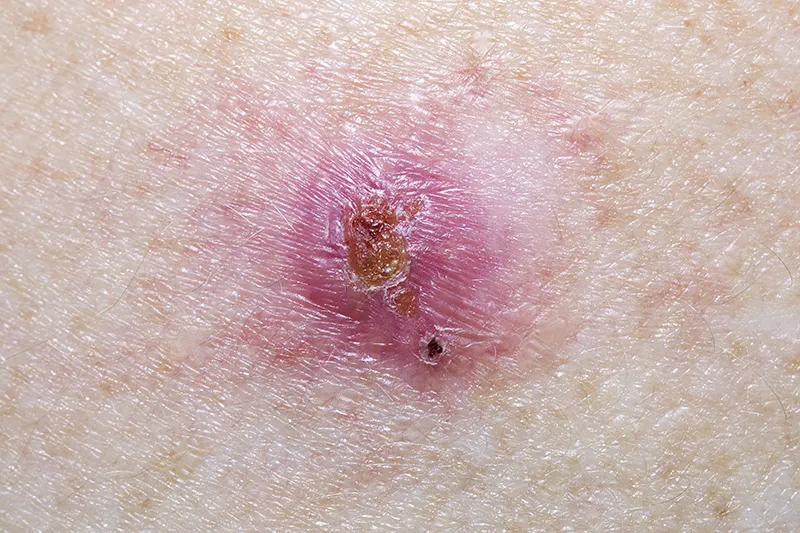
Basal cell carcinoma (BCC) is the most common type of skin cancer. It develops from basal cells located in the deepest layer of the epidermis and is most often caused by cumulative exposure to ultraviolet (UV) radiation from the sun or artificial tanning devices. While BCC rarely spreads to other parts of the body, it can continue to grow if left untreated, causing damage to surrounding skin and underlying tissue.
Signs and Symptoms
Basal cell carcinoma can vary considerably in appearance. It usually grows slowly and may be skin-coloured, pink, reddish or pigmented. Depending on the type, a BCC may appear as:
- A pearly, shiny or translucent bump or raised area
- A pink or reddish patch or plaque, which may be slightly scaly
- Visible small or branching blood vessels across the surface
- A pigmented lesion with brown, black, blue or grey colouring
- A lesion that bleeds, crusts or develops a central sore or ulcer
- A flat or scar-like area with poorly defined edges
BCC most commonly develops on sun-exposed areas such as the face, ears, scalp, neck and shoulders.
Common Types of BCC
- Nodular BCC: A pearly or reddish raised lesion, often with visible blood vessels, most commonly found on the head and neck
- Superficial BCC: A well-defined, pink or reddish scaly patch, often found on the trunk or limbs
- Morphoeic BCC: A flat, pale or reddish scar-like area with poorly defined borders
- Basosquamous carcinoma: Has features of both BCC and SCC and may behave more aggressively than typical BCC
Risk Factors
Your risk of developing BCC may be increased by:
- Long-term sun exposure
- Fair skin, light eyes or fair hair
- Increasing age
- A personal history of skin cancer
- Frequent sunburn, particularly during childhood
- Use of tanning beds
Diagnosis
Diagnosis is usually confirmed through clinical examination and biopsy. Your doctor may recommend additional investigations if there are features suggesting a higher-risk tumour.
Treatment Options
Treatment depends on the size, location and characteristics of the lesion, as well as individual patient factors. Options may include:
- Surgical excision
- Mohs micrographic surgery
- Curettage and cautery
- Cryotherapy
- Topical therapies (selected cases)
- Radiation therapy
- Rhenium-SCT for appropriate superficial lesions
Most BCCs can be successfully treated, particularly when diagnosed early.
This information is intended for educational purposes only and should not replace professional medical advice. Treatment decisions should always be made in consultation with a qualified healthcare professional.
Sources:
- Cancer Council Australia. About Skin Cancer. Available at: https://www.cancer.org.au/types-of-cancer/skin-cancer/about-skin-cancer (accessed August 2026).
- Cancer Council Australia. Non-melanoma Skin Cancer (Keratinocyte Cancer). Available at: https://www.cancer.org.au/types-of-cancer/non-melanoma-skin-cancer (accessed August 2026).
- Cameron MC, Lee E, Hibler BP, et al. Basal cell carcinoma: Epidemiology; pathophysiology; clinical and histological subtypes; and disease associations. J Am Acad Dermatol. 2019;80(2):303–317.
- Peris K, Fargnoli MC, Kaufmann R, et al. European consensus-based interdisciplinary guideline for diagnosis and treatment of basal cell carcinoma—update 2023. European Journal of Cancer. 2023;192:113254. doi:10.1016/j.ejca.2023.113254.